

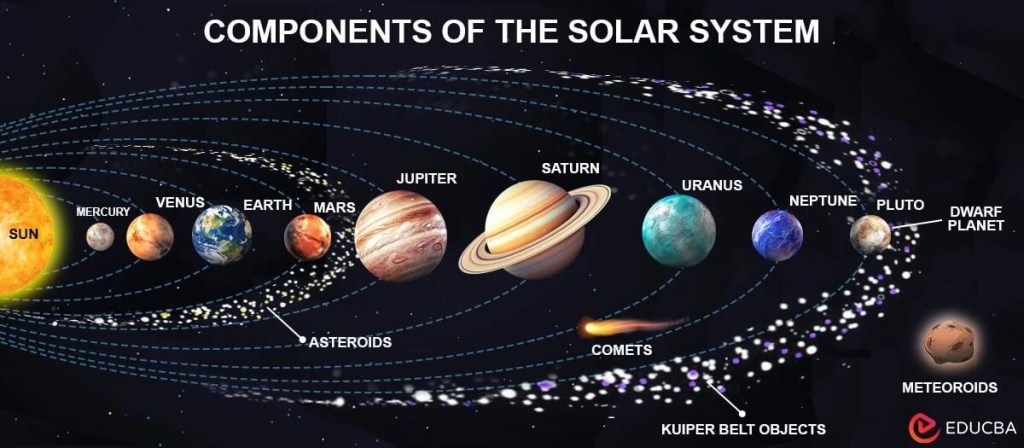
The eight planets, moons, dwarf planets, asteroids, comets all centered around the sun make up the “solar system”. It was formed 4.5 billion years ago.
Located in the Milky Way’s Orion star cluster, the solar system derives its name from the sun – which holds all its components by its powerful gravitational force.
SUN
The largest object in the solar system is the sun which is actually a star. It constitutes 99.8% of mass of the entire solar system. Its width is 100 times than earth but it appears small as it is 93 million miles away from earth. Nonetheless, planets are drawn towards it because of sun’s tremendous gravitational force.
The extremely high temperature at its core (27 million degree F/ 15 million degree C) together with powerful gravity (28 times that of earth) causes thermonuclear fusion – a process in which hydrogen molecules fuse to create helium and release immense energy in the form of heat and light capable of sustaining life on our very own planet ‘earth’.
MERCURY
This rocky planet is the smallest of all and its surface bears craters. Its devoid of air and has no moon. It ranks second in density among planets.
FACTS :
Type – terrestrial
Distance from sun – 58,000,000 km/ 36,000,000 miles.
Diameter – 4879 km/ 3031 miles.
Orbital period – 88 days.
Day length – 58 days.
Temperature – 430 degree C/ 800 degree F (day) , -180 degree C/ -290 degree F (night).
Gravity – 38% of that on earth.
VENUS
This terrestrial planet is similar to earth in terms of size and gravity, thereby referred to as ‘Earth’s sister’. Its atmosphere is thick, composed of CO2 which traps heat, making it the hottest planet of solar system. Clouds of sulfuric acid cover the planet.
FACTS :
Type – terrestrial
Distance from sun – 107,000,000 km/ 67,000,000 miles.
Diameter – 12,103 km/ 7520 miles.
Temperature – 465 degree C/ 900 degree F.
Orbital period – 225 days.
Day length – 243 days.
Gravity – 90% of earth’s.
EARTH
Our home, Earth with its water systems is the only known planet to support life and is the densest among planets of solar system.
FACTS :
Type – terrestrial
Distance from sun – 149,000,000 km/ 92,900,000 miles.
Diameter – 12, 742 km/ 7917 miles.
Orbital period – 365 days.
Day length – 24 hours.
Temperature – 15 degree C/ 59 degree F (average surface temperature)
MARS
The ‘Red planet’ as it is called is red because of rich content of iron oxide.
FACTS :
Type – terrestrial
Distance from sun – 228,000,000 km/ 142,000,000 miles.
Diameter – 6779 km/ 4212 miles.
Orbital period – 687 days.
Day length – 24.6 hours.
Temperature – -60 degree C/ -80 degree F (average).
Gravity – 62% of earth.
Moons – 2 (Phobos & Deimos)
JUPITER
This gas giant is the largest planet of our solar system. It is 11 times larger than earth. Terrible storms cover Jupiter and one of them called ‘the great red spot’ has been going on from 200 years.
FACTS :
Type – Jovian (gas giant)
Distance from sun – 778,000,000 km/484,000,000 miles.
Diameter – 139,820 km/ 86,880 miles.
Orbital period – 12 years.
Day length – 10 hours.
Temperature – -145 degree C/ -234 degree F(average), 24,000 degree C/43,000 degree F (core).
Gravity – 2.4 times earth.
Moons – >95 (Io, Europa, Callista, Ganymede – biggest moon in solar system).
SATURN
This planet is surrounded by rings composed of ice, rocks and dust. While the planet itself is made mainly of H2 & He. It is less dense than water and so would float in water.
FACTS :
Type – Jovian (gas giant).
Distance from sun – 1,400,000,000 km/ 886,000,000 miles.
Diameter – 116,460 km/ 72,364 miles.
Orbital period – 29 years.
Day length – 11 hours.
Gravity – 1.8 times earth.
Moons – 274 (Titan, Rhea, Enceladus, Mimas, Tethys).
URANUS
Clouds of methane impart blue color to Uranus. It is so much tilted that it rotates at nearly 90 degree angle from the plane of its orbit. H2 & He are major constituents of its atmosphere.
FACTS :
Type – Jovian (ice giant).
Distance from sun – 2,900,000,000 km/ 1,800,000,000 miles.
Diameter – 50,724 km/ 31,518 miles.
Orbital period – 84 years.
Day length – 17 hours.
Temperature – -213 degree C/ -353 degree F (average), 4727 degree C/ 8540 degree F (core).
Gravity – 86% of earth.
Moons – 28 (Miranda, Ariel, Titania, Oberon, Umbriel)
NEPTUNE
This dark blue planet is farthest from sun and has longest orbit.
FACTS :
Type – Jovian (ice giant).
Distance from sun – 4,500, 000,000 km/ 2,800,000,000 miles.
Diameter – 49,244 km/ 30,598 miles.
Orbital period – 165 years.
Day length – 16 hours.
Temperature – -218 degree C/ -360 degree F.
Gravity – 1.14 times earth.
Moons – 16 (Triton – largest).
DWARF PLANETS
These orbit the sun but do not have well defined orbits. There are 5 official dwarf planets : Ceres, Pluto, Haumea, Makemake & Eris in order of increasing distance from sun.
[Pluto was the nineth planet of solar system but in 2006 it was reclassified as a dwarf planet].
ASTEROID BELT
This is a flat rocky disc made up of remnants from solar system formation.
It is present between Mars and Jupiter.
Ceres – the dwarf planet is located within the asteroid belt.
KUIPER BELT
It is an icy belt beyond Neptune.
It hosts asteroids, comets and dwarf planet – Pluto.
OORT CLOUD
Farther away from Kuiper belt is icy and spherical Oort cloud which is considered as the edge of solar system as the gravitational and physical effects of sun end here.
Discover more from scienceqwest.com
Subscribe to get the latest posts sent to your email.
Particularly beautiful. A detailed description.