

One of the greatest scientific accomplishment of the 20th century has been the discovery of DNA (deoxyribonucleic acid) – the polymeric molecule which encodes the genetic data across its length. It forms the chemical basis of heredity capable of organizing into genes, the basic units of genetic information.
Avery, MacLeod and McCarty carried out a series of experiments in 1944 in which they were able to transfer capsule characteristics of a particular pneumococcus to another by inserting purified DNA from former to the latter. This led to the establishment that DNA contains the genetic code. They named the agent as “transforming factor” which later on came to be known as DNA.
To understand the structure of DNA, we must first know about its monomers, the nucleotides. So let us know what they are.
PURINES AND PYRIMIDINES
These are heterocyclic compounds, meaning they contain in addition to carbon, other atoms such as nitrogen. These are the building blocks of DNA and RNA.

PURINES
Purines have double ring in their structure. They are Adenine and Guanine.
PYRIMIDINES
These contain a single ring. They are Cytosine and Thymine in DNA while RNA has Uracil in place of Thymine.
NUCLEOSIDES
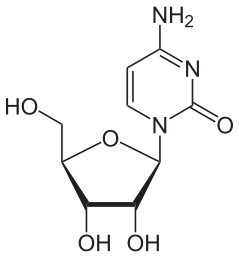
Nucleosides have a sugar linked to a ring nitrogen of a purine or pyrimidine by a beta-N-glycosidic bond. (Almost always to N-1 of pyrimidine or to N-9 of a purine).
The sugar in ribonucleosides is D-ribose and in deoxyribonucleosides is 2-deoxy-D-ribose.



NUCLEOTIDES
When a phosphoryl group is attached to hydroxyl group of the sugar of a nucleoside then it forms a nucleotide.

When there is a single phosphoryl group then it is a nucleoside monophosphate. If there are 2 or 3 phoshoryl groups then they will be known as nucleoside diphosphate and nucleoside triphosphate respectively. Phosphoryl group can be attached either to 5′- or 3′- positions of hydroxyl of sugar.
Most nucleotides are 5′- . For example – Adenosine 5′- monophosphate (AMP), Adenosine 5′- diphosphate (ADP), Adenosine 5′- triphosphate (ATP). (Prefix “5′-” is usually omitted while naming them).

DNA STRUCTURE
The structure of DNA was proposed by Watson, Crick and Wilkins in early 1950’s.
DNA is made up of two strands of polynucleotides arranged spirally forming a double helix.
The monomeric units that form the structure of DNA are deoxynucleotides. There are four such monomers that the DNA is composed of – deoxyadenylate, deoxyguanylate, deoxycytidylate and thymidylate.
The nucleotides of a single strand are joined by 3′,5′-phosphodiester bonds.
The 2 strands are held together by hydrogen bonds between purine and pyrimidine bases of adjacent strands. By rule, adenine always pairs with thymine (by 2 hydrogen bonds) and guanine with cytosine (by 3 hydrogen bonds).

In the test tube, double stranded DNA can exist in 6 forms (A to E and Z). Under physiologic conditions, the B form of DNA is usually found.
The width of B-DNA double helix is 2 nm (20 angstrom).
The distance spanned by one turn of B-DNA is 3.4 nm (34 angstrom).
There are 10 base pairs in a single turn of B-DNA.
POLARITY – DNA possesses polarity, that is, one end has a 5′- hydroxyl or phosphate terminal while the other has a 3′- phosphate or hydroxyl terminal. The two strands are antiparallel such that the two strands run in opposite directions, one in 3′ to 5′ and the other in 5′- to 3′ direction.
HANDEDNESS – DNA is right – handed which is explained by the fact that if one looks down upon the double helix, the base residues are seen to run spirally in clockwise direction.
CHARGAFF’S RULE – In a DNA molecule, the concentration of adenine is equal to that of thymine and the concentration of guanine is equal to that of cytosine.
TEMPLATE STRAND / NON CODING STRAND – This is the strand of DNA which is copied during RNA (ribonucleic acid) synthesis.
CODING STRAND – The strand opposite to the template strand is known as coding strand as the base sequence of this strand matches the base sequence of the RNA transcript (but contains uracil in place of thymine).

Discover more from scienceqwest.com
Subscribe to get the latest posts sent to your email.